


A cleaver is one of those tools you only really understand by using one. It looks brutal — a thick rectangular blade with serious weight — but in skilled hands it does work no other knife can match. This guide covers the main cleaver types, what each is for, and how to choose the right one for your work.
What a cleaver actually does
Where a butcher's knife cuts by slicing, a cleaver cuts by force. The thick spine and weight let it chop through bone and dense connective tissue that would dull or damage a regular knife. The wide flat blade also doubles as a tool for crushing garlic, smashing herbs, or scooping chopped ingredients off the board.
What a cleaver isn't is a substitute for a chef's knife. The thick blade displaces too much food for fine slicing, and the weight makes it tiring for any task that needs precision rather than force.
The main cleaver types
Meat Cleaver
The classic Western butcher's cleaver. Thick rectangular blade, heavy weight, designed for splitting bone, breaking down primal cuts, and heavy chopping work. The blade is usually 7-10 inches long with a 1-2 inch thick spine.
Best for: butcher shop primal breakdown, splitting ribs and joints, breaking through bone where a saw isn't appropriate.
Bone Cleaver
Heavier and thicker than a standard meat cleaver, designed specifically for cutting through bone rather than splitting alongside it. Some bone cleavers have a slight curve to the blade for chopping motion; others are straight-edged for downward force.
Best for: dedicated bone work, separating large joints, abattoir and slaughterhouse use.
Chinese Cleaver (Caidao)
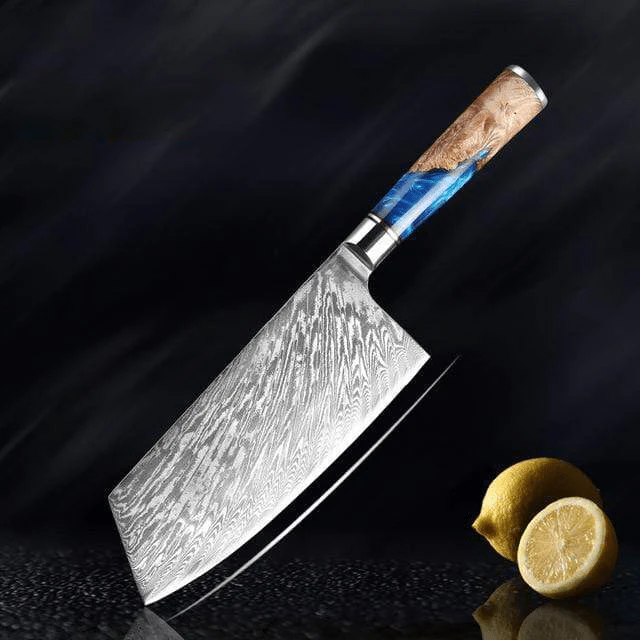
Wide rectangular blade like a Western cleaver but much thinner — typically 2-3mm at the spine versus 6-10mm on a meat cleaver. Despite the name, it's not for chopping bone; it's a versatile chef's knife in cleaver form, used for slicing, dicing, mincing, and crushing.
Best for: high-volume vegetable prep, sliced meat work, traditional Chinese cooking techniques. Not for bone.
Poultry Cleaver
Thinner and lighter than a meat cleaver, designed for precision portioning of poultry. The lighter weight makes it easier to make controlled cuts through smaller bones (chicken backs, duck joints) without overshooting.
Best for: poultry sectioning, game bird breakdown, smaller-scale joint work.
Flat Cleaver / Tenderiser
Wide flat blade with a blunt edge, used for flattening and tenderising rather than cutting. Some have a textured side for mechanical tenderising and a smooth side for shaping cutlets.
Best for: schnitzel/escalope preparation, cutlet shaping, tenderising tougher cuts.
What to check when buying
1. Blade steel
Cleavers take serious abuse — they need a hard, tough steel. Look for:
- High-carbon stainless steel — standard for quality commercial cleavers. Holds an edge, resists corrosion.
- Forged construction — forged cleavers are stronger than stamped equivalents. Look for visible forging at the bolster.
- Avoid generic kitchenware-brand cleavers — they're typically softer steel and won't hold up to bone work.
2. Weight
Cleaver weight isn't just specification — it's how the tool works. The weight does the cutting; you just guide it. As a rough guide:
- 500-700g — light, suitable for poultry and lighter cleaver work
- 700-1000g — standard butcher's meat cleaver weight
- 1000g+ — heavy, for serious bone work
Too light and you'll need to swing the cleaver hard to cut through bone — dangerous. Too heavy and you'll fatigue quickly. Match to your hand strength and your work.
3. Handle
Cleaver handles take vertical force every time the blade comes down. Look for:
- Full-tang construction (steel extends through the handle)
- Riveted handle scales rather than slip-on grips
- Material rated for wet, fatty environments — polymer, treated wood, or stainless steel
- Ergonomic shaping that won't shock the hand on impact
4. Balance
A well-balanced cleaver feels heavy near the blade and lighter at the handle — the weight where it does the cutting. Pick the cleaver up and balance it on a finger near the bolster (where blade meets handle); the balance point should be just forward of that.
5. Edge geometry
Cleaver edges are sharpened at a steeper angle than knives — typically 25-30 degrees per side, versus 15-20 for a chef's knife. The steeper angle is more durable for impact work but less keen. Don't try to sharpen a cleaver to knife-edge sharpness; you'll just chip it.
Care and maintenance
- Hand wash only. Dishwashers will damage handles and may dull the blade against other items.
- Dry immediately. Even stainless steel will discolour if left wet, especially after contact with bone and blood.
- Sharpen on a coarser whetstone than you'd use for a knife. A 1000-2000 grit stone is right; don't go finer.
- Store on a magnetic strip or in a dedicated knife block. Cleavers in drawers damage other tools.
- Inspect after each use for chips or rolled edges — address immediately, don't let damage compound.
Quick recommendations
- General butcher shop work: 750-900g forged meat cleaver, F. Dick or comparable. Browse our F. Dick range.
- Poultry and game: Lighter poultry cleaver, 500-650g, paired with a butcher's knife for muscle work.
- Volume vegetable prep: Chinese cleaver (Caidao), thinner blade.
Browse our full knives collection for cleavers and matched butcher's tools, or get in touch for advice on the right cleaver for your work.


