



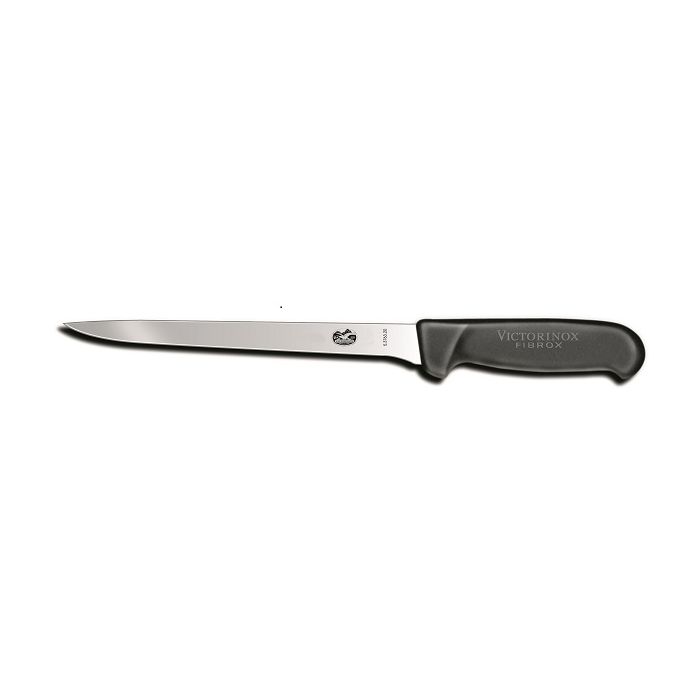
Filleting fish is one of the most demanding cutting tasks in food preparation — narrow, flexible blades follow the contour of the spine to remove maximum flesh, leaving bones behind. A general-purpose kitchen knife won't do this work, and a butcher's knife is the wrong tool entirely. This guide covers the three Victorinox filleting knives we recommend for fishmongers, butcher shops with fish counters, and serious cooks.
What makes a filleting knife different
A filleting knife is built for one job: separating fish flesh from bone with the minimum waste. That means:
- Narrow blade. Most filleting knives are around 6–8" long but only 12–18mm wide. The narrowness lets the blade move through the fish without displacing flesh.
- Flexible blade. The blade flexes to follow the curve of the spine and rib cage. A rigid blade can't follow the contour and wastes flesh.
- Sharp, low-angle edge. Filleting knives are sharpened to around 12–15 degrees — finer than a butcher's knife — to slice through delicate flesh cleanly.
- Grippy handle. Wet, slippery fish hands need a handle that grips back.
Victorinox 8" Fish Filleting Knife (Narrow Flexible Blade)
The full-size professional fish filleting knife. The 8-inch blade gives the reach for larger fish — salmon, sea bass, large trout — and the narrow profile lets it move through the fish smoothly. Standard Victorinox Fibrox handle: grippy, dishwasher safe, all-day comfortable.
Best for: anyone filleting fish daily, especially larger species.
Victorinox 8" Filleting Knife (Flexible Blade, Blister Pack)
Same 8-inch flexible blade as the dedicated fish knife, but versatile across other tasks too — fish filleting, poultry boning, trimming delicate meats. The blister pack is the retail format and is what we typically supply for customer sales rather than trade kits.
Best for: shops that want a multi-purpose filleting knife rather than a fish-only specialist.
Victorinox 6" Rosewood Filleting Knife (Flexible Blade)
The shorter 6-inch (16cm) blade is better suited to smaller fish — trout, mackerel, sole — and the rosewood handle is the more upmarket Victorinox finish. Less grip in wet hands than the Fibrox handles, but visually distinct and a favourite among chefs and gift buyers.
Best for: smaller fish work, premium gift sets, displays.
Choosing between them
Quick guide:
- Daily fish work, full size fish → 8" Narrow Flexible (Fibrox handle)
- Mixed filleting and boning work → 8" Flexible Blade (blister pack)
- Smaller fish, premium feel → 6" Rosewood
Sharpening filleting knives
Filleting knives need a finer edge than other knives — typically 12–15 degrees. Use a fine whetstone rather than a sharpening steel, and keep the angle shallow. A rough sharpening steel will damage the delicate edge.
Care
- Hand wash, dry immediately — fish acids can affect the steel if left wet
- Store in a knife block or magnetic strip, never loose in a drawer
- Avoid using on bones or shells — that's not what filleting knives are designed for
Browse our fishmonger and filleting knife range or the full Victorinox knives collection.


