



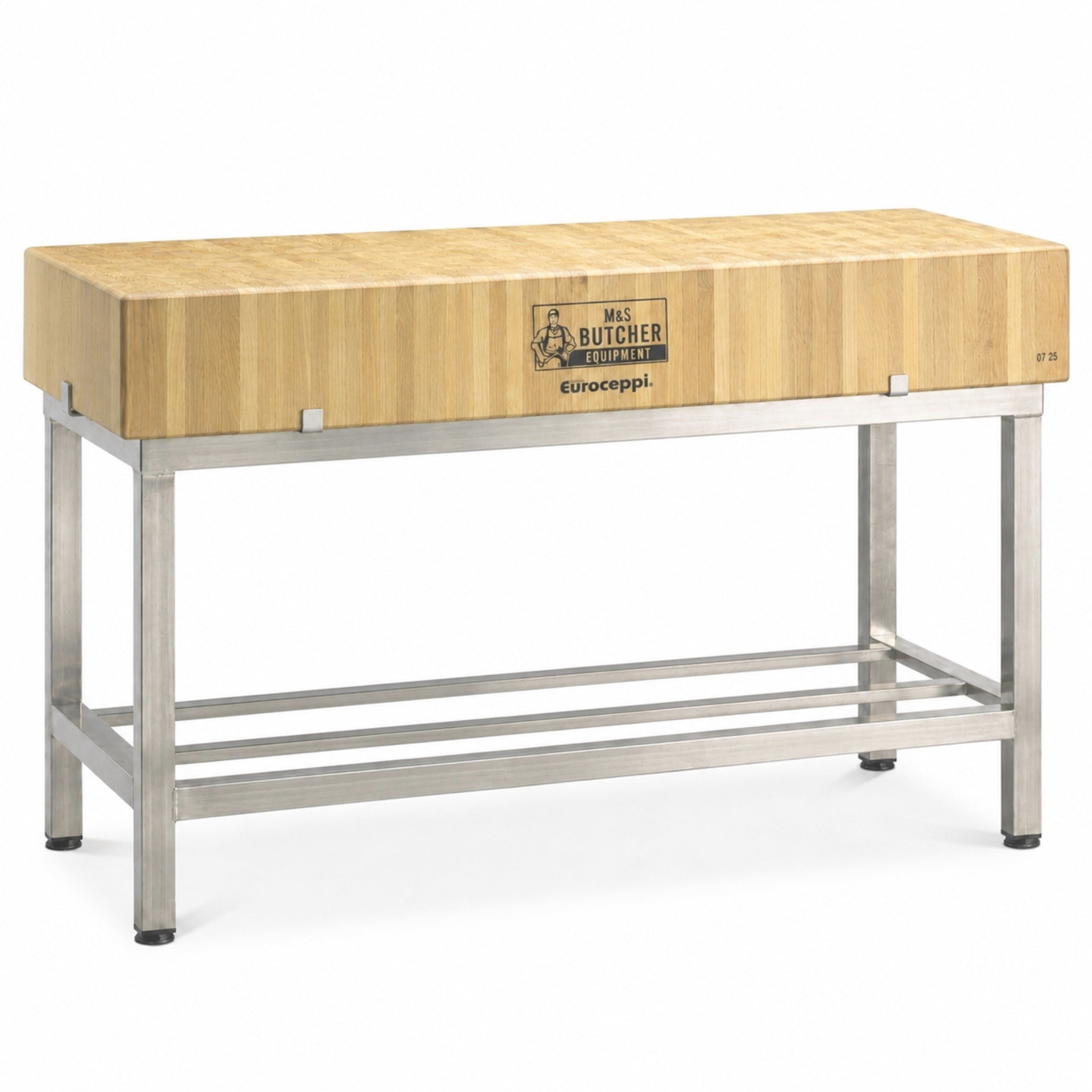
A wooden butcher's block is the centrepiece of a serious butcher shop — the working surface where the real cutting happens. Plastic chopping boards have their place for some tasks, but for primal breakdown and serious meat work, nothing beats a quality wooden block. Our M&S Italian Black Locust Butcher Blocks are sourced from one of the densest, hardest, most naturally antibacterial hardwoods available. Here's why this wood matters and which size fits your operation.
At a glance
- Wood species: Italian Black Locust (Robinia pseudoacacia)
- Construction: End-grain butcher's block
- Sizes: From 2ft × 2ft up to 6ft × 2.5ft
- Origin: Italy
- Use case: Primary butcher's block, primal breakdown, heavy chopping work
Why Black Locust wood
Black Locust (Robinia pseudoacacia) is one of the densest hardwoods used in butchery. The technical properties matter:
- Janka hardness rating around 1700: harder than oak (1290) and hard maple (1450). The block resists knife scoring better than alternative woods.
- High specific gravity (0.69): the wood is heavy, which gives the block stability under chopping force without it moving on the frame.
- Naturally rot-resistant: contains tannins and extractives that resist bacterial and fungal growth. This is the property that historically made Black Locust the wood of choice for outdoor structures — it lasts decades in conditions that destroy other timbers.
- Low water absorption: the dense grain doesn't soak up blood and juices the way softer woods do, which is critical for hygiene.
The antibacterial properties
This is the part of wooden butcher's blocks that people are often surprised by. Research has shown that bacteria on the surface of a clean hardwood block die off significantly faster than they do on plastic surfaces. The mechanisms aren't fully understood, but contributing factors include:
- Natural antimicrobial compounds in the wood
- Capillary action drawing bacteria into the wood structure where they dry out
- Hygroscopic behaviour that creates an inhospitable environment for bacterial replication
This doesn't mean wooden blocks are self-cleaning — they still need proper cleaning and care — but it does mean a well-maintained wooden block is genuinely hygienic, not despite being wood but partly because of it.
End-grain construction
The way the wood is oriented in a butcher's block matters as much as the species. End-grain construction (where the end of the wood fibres faces up, like the end of a log) has two practical advantages over edge-grain or face-grain:
- Self-healing. Knife edges cut between the wood fibres rather than across them, and the fibres close back over the cut. Block surfaces stay smooth for decades.
- Knife-preserving. Cutting into end-grain wood is gentler on the blade edge than cutting across fibre. Knives stay sharp longer on a quality end-grain block.
Size guide
Match the block to your operation:
- 2ft × 2ft — small workstation, secondary chopping surface, market stall or mobile operation
- 3ft × 2ft — standard primary block for smaller butcher shops
- 4ft × 2ft — typical main block for most independent butcher shops
- 5ft × 2ft / 5ft × 2.5ft — larger primary block for high-volume shops handling primal cuts
- 6ft × 2.5ft — maximum size, for serious processing operations and butchery training facilities
If in doubt, size up rather than down. A slightly larger block gives you working space; a slightly smaller one becomes a daily frustration.
The natural look
Black Locust has a distinctive grain pattern and colour. New blocks present a warm golden-brown that darkens over time with use and oil treatment, eventually reaching a rich reddish-brown patina. This isn't a defect to prevent — it's part of the character that develops as the block ages. A 20-year-old well-cared-for Black Locust block has visual depth that no manufactured material matches.
Care and maintenance
Wooden butcher's blocks need real care, but the procedure is simple:
- Daily clean: scrape off bulk debris, wipe with hot water and mild soap, rinse, dry immediately. Don't soak.
- Sanitise: use a food-safe sanitiser rated for wood, or a saturated salt scrub followed by lemon (the classic, time-tested method).
- Oil regularly: food-safe mineral oil (or specifically butcher's block oil) every 2-4 weeks. The oil prevents the wood drying out and cracking.
- Never put in a dishwasher or pressure wash. Water saturation will warp and split a wooden block over time.
- Don't use detergent excessively. Strong soaps strip the natural oils that make the wood antibacterial.
- Plane down when scored. A cabinet maker can resurface a wooden block when knife marks become significant — typically every 5-10 years in commercial use.
Heat resistance
Black Locust handles heat better than most other butcher's block woods — you can place hot pots on it briefly without scorching — but use a trivet for prolonged heat. Repeated thermal cycling will eventually open up the wood structure.
Lifespan
A well-cared-for Black Locust butcher's block in daily commercial use will last 25-50 years before needing significant restoration. This is genuinely lifetime equipment — the kind of purchase that pays for itself many times over in durability and performance compared to plastic alternatives.
Wooden block vs polytop vs stainless
Each surface has its place. Most established butcher shops use all three:
- Wooden block — primal breakdown, heavy chopping, knife-intensive work
- Polytop (HDPE) tables — daily prep, portioning, general cutting. See our polytop tables guide.
- Stainless steel surfaces — weighing, packing, non-cutting tasks
The wooden block is the centrepiece. The other surfaces support it.
Verdict
If you're building a serious butcher shop, a quality Italian Black Locust block is one of the few pieces of equipment that genuinely lasts decades. The wood properties — hardness, density, natural antibacterial action, knife-friendliness — make it the right material for the job. Initial cost is higher than plastic alternatives; per-year cost over the block's lifespan is dramatically lower.
Browse our full range or get in touch for size advice and trade pricing.


