



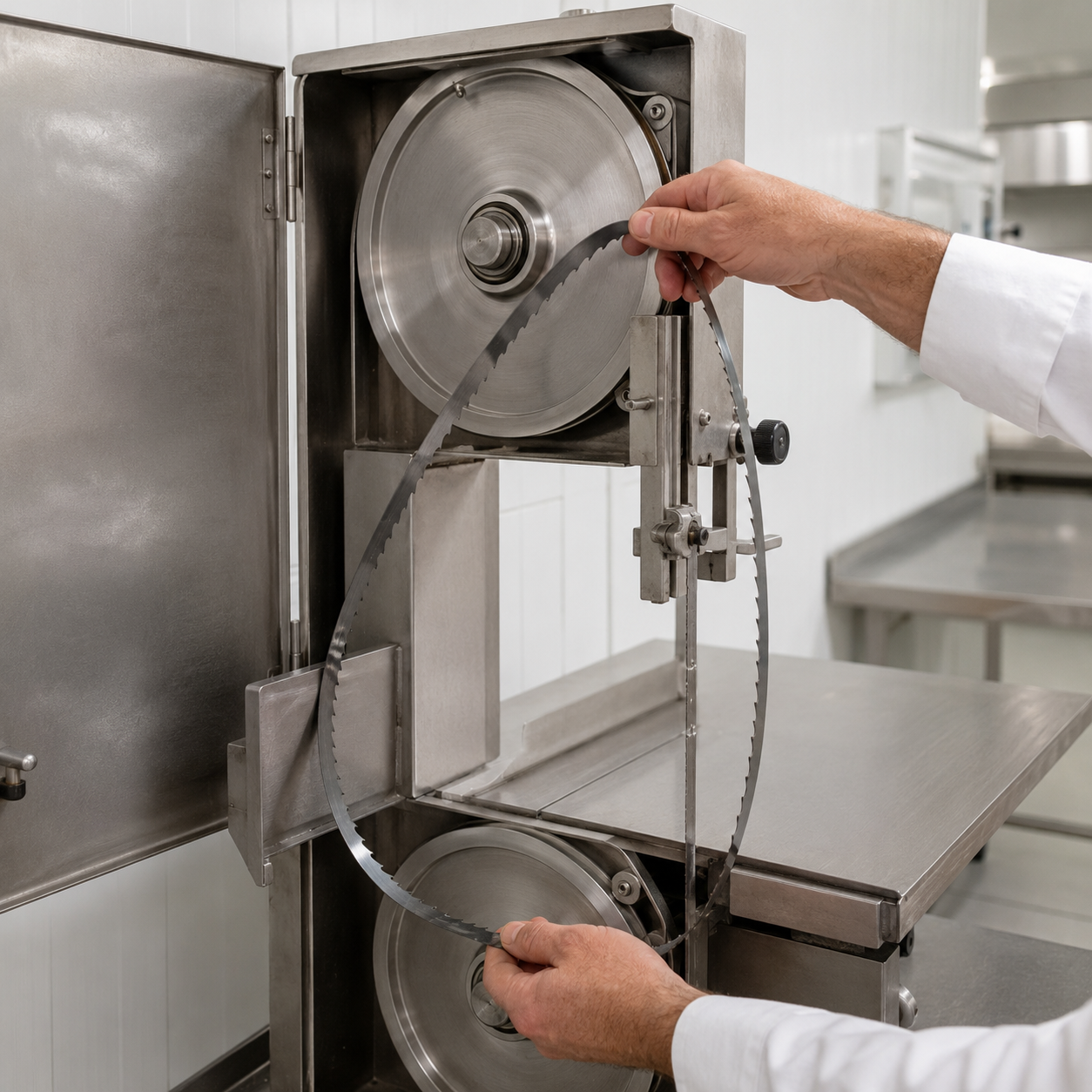
The wrong blade wastes meat, wears out fast, and can come off the wheels mid-cut. Here's how to pick the right blade for what you're cutting, and how to find the exact length your machine needs.
Shop bandsaw blades →Every butcher shop treats its bandsaw blade as a consumable, but not every blade is the same. Tooth spacing, steel grade and, critically, length all have to match your meat and your machine, or you end up with a blade that clogs, snaps, or won't tension correctly. At M&S Butcher Equipment we stock commercial bandsaw blades UK-wide in over fifty lengths, sold in packs of five, so getting a fresh set on the machine is simple once you know what you're looking for. Here's how to choose.
In this guide
- Match the blade to your meat and cutting volume
- Popular commercial bandsaw blade lengths
- How to identify the right blade length for your machine
- Why choose our commercial bandsaw blades
- Frequently asked questions
Match the blade to your meat and cutting volume
Blade teeth are measured in TPI — teeth per inch, counted gullet to gullet rather than tip to tip — and TPI is the single biggest factor in how a blade performs on different meat. A lower TPI blade has bigger gullets between the teeth, which clear waste faster and bite more aggressively, making it the right choice for bone-in joints, carcasses and frozen product where you need speed and don't need a polished finish. A higher TPI blade spreads the cutting load across more teeth for a smoother, cleaner line, which matters more for fresh boneless meat, poultry and any cut where presentation counts and splintered bone is a problem.
Cutting volume matters too. A shop running one bandsaw flat out all day, mostly on bone-in beef and lamb, is better served by a coarser, more aggressive tooth than a specialist counter cutting delicate boneless portions to order. Our bandsaw blades are manufactured in the UK from high-grade carbon steel with a 4 TPI configuration — the genuine all-rounder that handles fresh and frozen meat, including bone, without needing to switch blades between jobs.
Popular commercial bandsaw blade lengths
Length is fixed by your specific machine, not by preference, so we stock blades from around 60 inches up to well over 150 inches, all sold in packs of five and individually wrapped to stop them corroding in storage. Here are three of our most popular lengths, representative of compact, mid-size and larger production bandsaws.

Suited to compact and table-top bandsaws, this is a popular choice for smaller butcher shops running mixed fresh and frozen product on one machine.

A mid-size length that fits many of the commercial bandsaws found in butcher shops and small processors cutting steady daily volume.

The longer option for larger production bandsaws, built to the same 4 TPI high-grade carbon steel spec as the rest of the range.
Not sure your machine takes one of these? Browse the full bandsaw blades collection and filter by compatible machine — including Kolbe K430 and K440, Medoc STL and ST ranges, SAP SM2020 and Dadaux SX220 — to find your exact length.
How to identify the right blade length for your machine
Fitting the wrong length blade is one of the most common bandsaw mistakes, and it's rarely obvious until the blade won't tension properly, tracks off the wheels, or snaps under load. There are three reliable ways to confirm the length you need.
1. Check your machine's nameplate or model. Bandsaw blade length is fixed by the model, so if you know your make and model — Kolbe, Medoc, SAP, Dadaux and similar — you can filter our bandsaw blades collection by compatible machine and match it directly.
2. Measure your old blade. Lay it flat on the floor, mark one tooth or the weld point, then run a tape measure around the full loop back to your mark. That total is your blade length.
3. No blade to measure? Use the wheel-and-centre method. Measure the diameter of each wheel the blade runs on, multiply each by pi (3.14) and divide by two, then add the centre-to-centre distance between the wheel axles twice. Add all of that together for the blade length you need to order.
If you're at all unsure, send us your machine's make, model and serial number before you order — a blade that's even a little too long or short won't tension safely.
Why choose our commercial bandsaw blades
High-grade carbon steel blades made in Britain, not imported generic stock.
One tooth configuration that handles fresh and frozen meat, including bone, without swapping blades.
Cost-effective packs so a fresh blade is always on the shelf when one wears out.
Over fifty lengths held in stock, from compact table-top saws to full production bandsaws.
Get the right blade first time
Confirm your machine's length, pick the right tooth for your meat, and order in packs of five with UK delivery.
Shop bandsaw blades →Frequently asked questions
Prices and stock levels correct at the time of writing and may change – always check current product pages for the latest pricing and availability. Tags: bandsaw blades, commercial bandsaw blades uk, butcher equipment, buying guide.


