



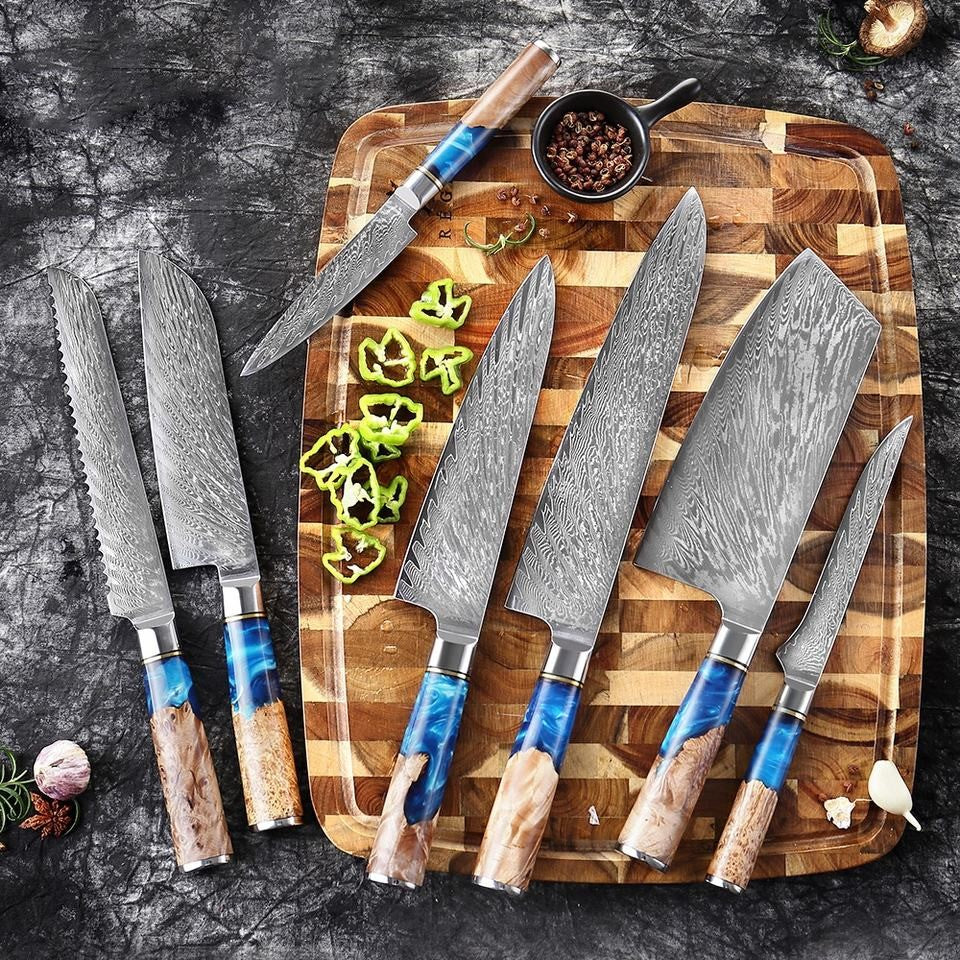
The Japanese Damascus Knife Set sits at the high-aesthetic end of the kitchen knife market. Forged in the traditional Japanese layered-steel technique, these knives combine genuine cutting performance with the distinctive rippled pattern that gives Damascus steel its name. They're not a working butcher's tool — they're a chef's tool or a collector's piece. Here's what you're actually buying.
At a glance
- Construction: Damascus-pattern layered steel
- Core blade material: VG-10 high-carbon stainless steel
- Outer layers: Multiple folded steel layers (typically 33-67 layers)
- Edge angle: 15 degrees (Japanese-style fine edge)
- Origin: Japan
What "Damascus" actually means
Modern Damascus steel knives are made by layering different steels together — typically a hard, high-carbon steel core sandwiched between softer outer steels — then folding the resulting billet multiple times during forging. Each fold doubles the number of layers; 5-6 folds produces the typical 33-67 layer count seen in Damascus blades.
The resulting pattern (the visible rippling on the blade surface) is the visible record of these layers, etched out by acid treatment after forging. Each blade's pattern is unique — a fingerprint of how the steel was folded and worked.
The construction has two practical benefits beyond aesthetics:
- The hard core holds a fine edge that stays sharp through extended use
- The softer outer layers absorb impact and provide structural toughness, preventing the brittle hard core from chipping
VG-10 steel
The most common core steel in Japanese Damascus knives is VG-10 (or its variants VG-MAX, VG-10 Damascus). VG-10 is a high-carbon stainless steel originally developed for Japanese knifemakers. Key properties:
- High hardness: typically 60-62 HRC, which holds an extremely fine edge
- Excellent edge retention: Sharpening intervals 3-4x longer than typical Western stainless steels
- Corrosion resistance: Genuine stainless, not just rust-resistant
- Takes a polished edge well: Suitable for the mirror-finish sharpening Japanese knives are known for
The trade-off: VG-10 is harder to sharpen than softer Western steels, and over-aggressive sharpening can chip the edge. These knives need careful maintenance, not casual sharpening.
Typical knives in the set
A Japanese Damascus knife set typically includes:
- Chef's knife (Gyuto) — the Western-style main knife, 20-25cm blade
- Santoku — the Japanese all-purpose knife, 17-19cm blade with a slightly different profile to the Gyuto
- Paring knife — 8-10cm for detail work and peeling
- Utility knife — 12-15cm for mid-size tasks
Some sets also include a serrated bread knife or a slicing knife. Quality sets come with a knife block or display case; many include a honing rod or whetstone for maintenance.
The handle
Japanese Damascus knife handles vary by maker. Common options:
- Traditional Japanese (Wa-handle): Octagonal or D-shaped wood handle, lighter and more rear-balanced
- Western (Yo-handle): Full-tang riveted handle with bolster, more familiar to Western cooks
- Composite resin: Modern stabilised wood-resin composites; durable and visually striking
Handle choice is largely personal — try both styles if you can before buying. Wa-handles are lighter; Yo-handles feel more familiar to Western cooks.
Who it's for
- Serious home cooks who want the best edge experience and appreciate the craftsmanship
- Chefs in fine-dining or sushi/Japanese kitchens where the knife's performance and visual quality matter
- Collectors — high-quality Damascus knives appreciate as collector's pieces
- Premium gift purchases for food professionals
Not the right fit for a working butcher shop. The fine VG-10 edge is built for delicate slicing, not bone or heavy meat work — use a butcher's knife or F. Dick range for that. The Japanese Damascus is a precision instrument, not a workhorse.
Sharpening
Japanese Damascus knives require Japanese-style sharpening:
- Angle: 15 degrees per side, not 20 (the Western angle)
- Stones: Water stones, typically progression from 1000 → 3000 → 8000 grit. See our whetstone range.
- Avoid sharpening steels. Standard Western sharpening steels are too coarse for VG-10 edges and will damage them. Use a ceramic honing rod if you want to maintain between sharpenings.
- Frequency: Most Japanese Damascus knives need full sharpening only every 2-3 months in regular use — the edge retention is that good.
Care and maintenance
- Hand wash only — absolutely. Dishwashers will damage these knives badly.
- Dry immediately after washing. The high-carbon core can spot if left wet.
- Wood handles need occasional oiling with food-safe mineral oil to prevent drying out.
- Store on a magnetic strip or in the case. Loose in a drawer is not acceptable for knives at this price point.
- Never use on bone or frozen food. The hard, fine edge will chip.
Verdict
A genuine craftsmanship purchase at the upper end of kitchen knives. The performance is real — these aren't decorative; they cut better than virtually any other knife at the same price point. The trade-off is care: they demand respect, proper sharpening, and handling within their design parameters. For chefs and serious cooks who'll use them as designed, they're a long-term investment that delivers daily.
Browse our full knife sets collection, including Japanese options, or get in touch for advice on the right set for your use.


