



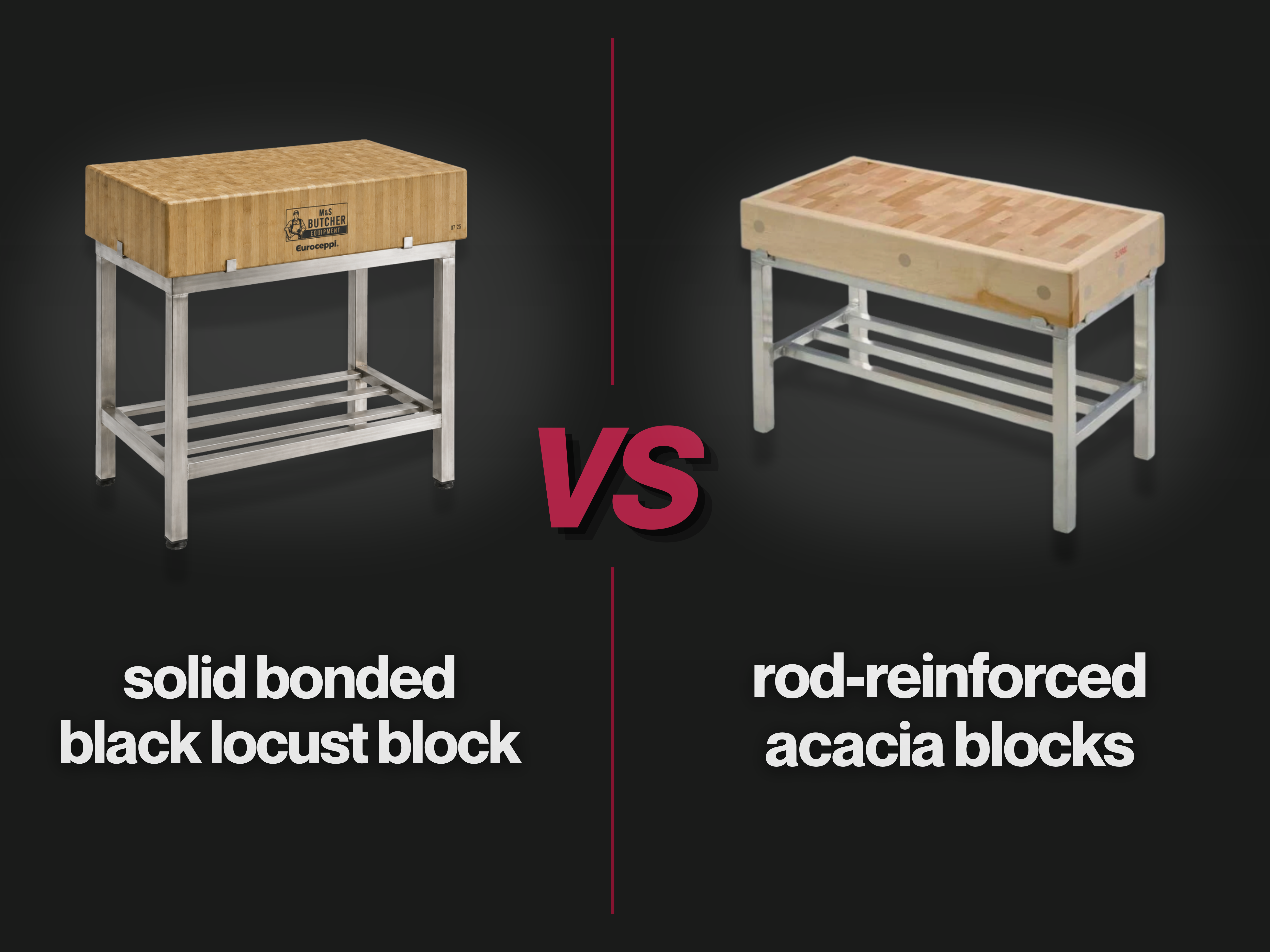
With over 30 years supplying the UK meat trade, here is how to choose a butcher block that lasts — and why the way it is built matters more than the price on the label.
Shop wooden butcher blocks →The short answer: almost every serious wooden block is end-grain, so a knife sinks between the upright fibres and they close again after each cut. What really separates them is the timber and how the block is held together. The common UK trade block is acacia staves clamped with steel tie-rods. A premium block is solid, bonded black locust — a harder, denser, naturally more hygienic timber held together by the strength of the bond and the wood itself. Both are good tools; one is built to last a generation.
In this guide
- What is a butcher block actually made of?
- What are rod-reinforced acacia blocks?
- What makes a solid black locust block different?
- Head to head: which lasts longer?
- Which butcher block should I choose?
- Frequently asked questions
What is a butcher block actually made of?
Nearly all professional wooden blocks share one thing: end-grain construction. The wood is arranged with the cut ends of the fibres facing up, so a blade slips down between the fibres instead of slicing across them. The fibres part under the knife and close again afterwards, which is what makes a proper block so kind to your edge and so resistant to daily chopping and cleaver work. That is common to good blocks either way, so it is not where the real difference lies.
The difference is in two things: which timber the block is made from, and how the pieces are held together once they are assembled. Those two choices decide how hard the surface is, how hygienic it stays, and how many years it gives you.
What are rod-reinforced acacia blocks?
This is the block most UK butchers picture when they think of a butcher's block, and for good reason — it is a capable, sensibly priced workhorse. It is built from interlocking staves of acacia, a dense tropical hardwood, glued and then drawn tight with steel tie-rods that run right through the body of the block. Those rods keep the segments under constant tension, which helps the block resist the expansion and cracking that come with heavy use and changing humidity. The blocks are usually oven-dried to limit warping, treated with food-safe oils, and reversible so you can spread wear across two faces.
What is good about it: it is affordable, available in every size, easy to maintain and genuinely reliable. For a lot of buyers it is exactly the right block.
Worth knowing: the block leans on that steel hardware and on the seams between the staves. Those joints are the areas to watch over the years — if a block is allowed to dry out, seams can begin to open. Acacia is hard, but it is not the hardest or the most naturally rot-resistant timber you can buy.
What makes a solid black locust block different?
Our wooden blocks take a different route to durability. Instead of leaning on steel rods, a solid bonded end-grain block is built around the timber itself — seasoned black locust (Robinia pseudoacacia), one of the hardest, densest woods you can put under a cleaver.
Black locust is naturally rot- and moisture-resistant, carries natural antibacterial properties that make it a hygienic choice for raw meat, and develops a rich golden-to-reddish patina as it ages. Where the common trade block is clamped together with steel tie-rods, a solid black locust block is built to hold on the strength of the bond and the density of the timber. The result is a harder, more naturally resilient surface that resurfaces cleanly for decades — a properly cared-for block can genuinely outlast the person who bought it.
Worth knowing: you pay more, because you are paying for the timber, the craft and the finish. It is a premium buy, and we will always say so honestly.

A full-length block for high-volume butchery and abattoir work, where you want the hardest, longest-lived surface you can buy.

The go-to size for a working bench: enough surface to break down and portion, in hard-wearing solid black locust.

Solid black locust in the most popular counter size — ideal for a compact prep station or a home enthusiast who wants a block for life.
Head to head: which lasts longer?
| Rod-reinforced acacia | Solid black locust | |
|---|---|---|
| Timber | Acacia (hard) | Black locust (harder, denser) |
| Construction | Staves clamped by steel tie-rods | Solid bonded end-grain |
| Natural hygiene | Good | Excellent — naturally antibacterial |
| Longevity | Very good with care | Exceptional |
| Look | Utilitarian | Premium, ages beautifully |
| Price | £ | ££ |
Which butcher block should I choose?
High-volume butchery and abattoir work. If you are breaking carcasses daily and want the hardest, longest-lived surface on the market, a solid black locust block earns its price back over its lifetime. If budget has to stretch across several benches, a rod-reinforced acacia block is a sound, honest choice.
Caterers and restaurants. A block on show in an open kitchen benefits from the look of solid black locust as much as its performance — a working tool that doubles as a statement piece.
Home cooks and enthusiasts. If you want a once-in-a-lifetime block that becomes an heirloom, black locust is the one to own. If you want a capable block at a friendlier price, acacia will not let you down.
Prefer a wipe-clean synthetic surface for wet work or fish? Our polytop tables are a hygienic alternative, and our butcher shop equipment checklist covers how a block fits into the rest of your setup.
The UK's home of professional butcher blocks
Solid black locust blocks in every size from 2ft to 6ft, plus aluminium frames, block brushes and scrapers to keep them in shape. Trade pricing and free UK mainland delivery over £75.
Shop all butcher blocks →Frequently asked questions
What is the best wood for a butcher block?
For professional use, a dense hardwood with good natural moisture resistance is ideal. Black locust is one of the hardest and most naturally rot- and bacteria-resistant timbers available, which is why it is prized for premium blocks. Acacia is also hard and hard-wearing, and is the most common timber in the standard trade block.
What is the difference between a solid block and a rod-reinforced block?
Both are usually end-grain and both are glued during assembly. A rod-reinforced block adds permanent steel tie-rods that run through the body to clamp the staves together. A solid bonded block relies on the strength of the bond and the density of the timber to hold together, without steel rods running through it.
How thick should a butcher block be?
Professional blocks are typically around 200mm (8in) thick. The extra depth adds weight and stability so the block stays put and absorbs the shock of a cleaver, and it leaves plenty of material to resurface over the years.
How do I care for a wooden butcher block?
Scrape it down after use with a block scraper or wire brush rather than soaking it, keep it out of standing water, and oil it periodically to stop it drying out. Turn and reverse the block to spread wear. Looked after this way, a good block lasts for decades.
Is a wooden block or a polytop better?
Wood is the traditional choice for chopping and cleaver work and is naturally kinder to your knives. A polytop is a synthetic surface that is easy to wipe down and well suited to wet work and fish. Many shops keep both for different tasks.
How much does a professional butcher block cost?
A solid black locust block starts from around £500 for a 2ft x 2ft and rises with size and stand options. Larger full-bench blocks run to well over £1,500. It is an investment, but spread across its lifetime it is one of the best-value purchases on the bench.
Prices correct at the time of writing and may change. Always check current product pages for the latest pricing and availability.


