



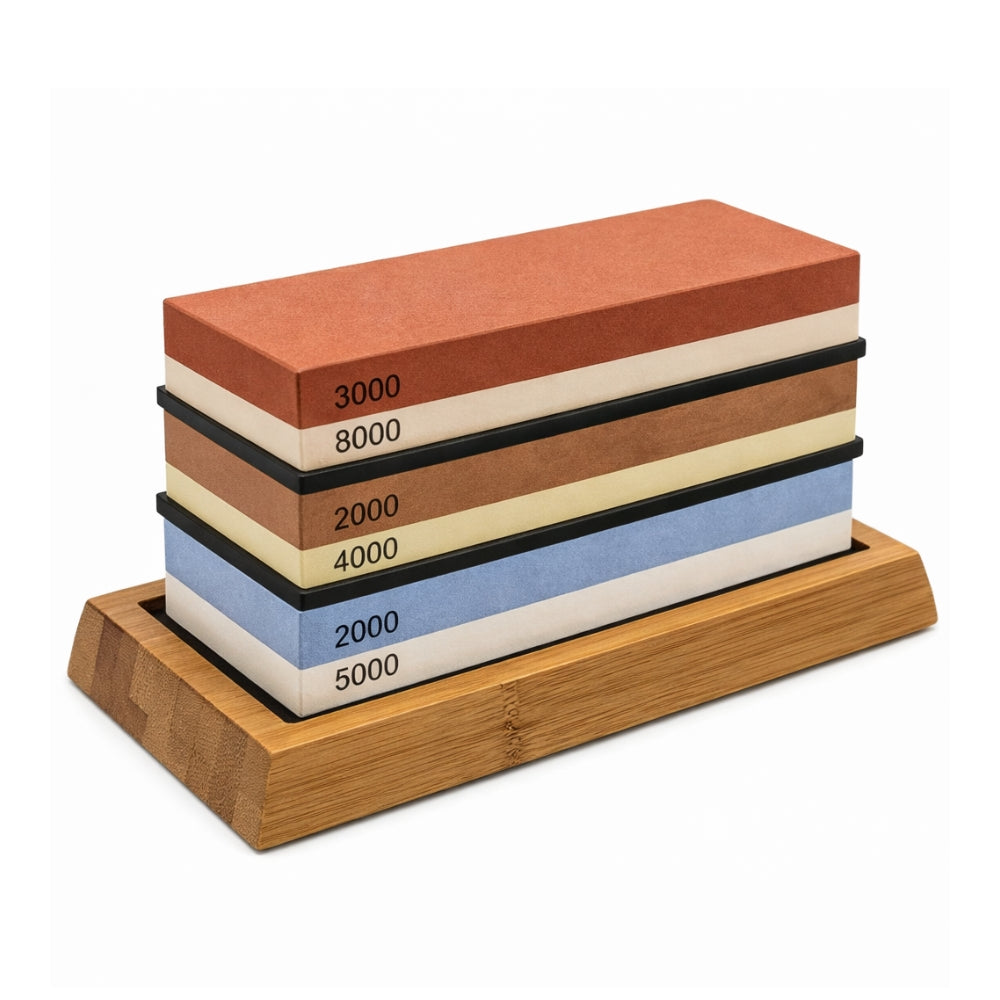
A whetstone produces the best edge a knife can have — sharper than a steel can deliver, finer than any pull-through sharpener. The M&S Japanese Whetstone Set is a three-stone pack covering every grit you'll need to take a knife from blunt to razor edge, supplied with a bamboo holder. This guide covers what's in the set, what each grit is for, and the basics of how to use it.
At a glance
- Pack contents: 3 combination whetstones + bamboo holder
- Stone dimensions: 180mm × 60mm × 29mm each
- Grit combinations:
- • Stone 1: 2000 / 4000 grit
- • Stone 2: 3000 / 8000 grit
- • Stone 3: 2000 / 5000 grit
- Holder: Bamboo with non-slip base
- Lubricant: Water (water stones)
Understanding grit numbers
Whetstone grit is the inverse of how coarse the abrasive is — lower number = coarser stone = removes more material faster. The job at each level:
- 200-800 grit: Repair work — chipped or badly damaged edges. Not in this set; you'd need a coarser repair stone for major damage.
- 1000-2000 grit: Initial sharpening on a dull blade. Sets the geometry.
- 3000-5000 grit: Refining and developing the edge. The working sharpness for most kitchen and butcher knives.
- 6000-8000 grit: Polishing. Takes the edge to scary-sharp, mirror-finish territory — suitable for Japanese knives, fish filleting, fine detail work.
Which stone for which knife
Practical guide:
- Butcher's knives, Western chef's knives: 2000 → 4000 or 2000 → 5000 progression. The European-style edge (around 20 degrees) doesn't benefit much from going past 5000.
- Japanese knives, santokus: 3000 → 8000 progression. The thin Japanese edge (around 15 degrees) holds the higher polish well.
- Fish filleting knives: 3000 → 8000 for the keen, polished edge needed for clean filleting.
- Paring and detail knives: 2000 → 4000 typically sufficient.
How to use a whetstone
- Soak the stone in water for 10-15 minutes (until bubbles stop rising). Water stones must be wet.
- Set the stone in the bamboo holder, coarse side up.
- Set your angle — around 15 degrees for Japanese, 20 degrees for European. Be consistent.
- Draw the blade across the stone from heel to tip, using light pressure. 8-10 strokes per side.
- Check for the burr — a slight roughness on the opposite side from the one you've been working. Once you feel it, switch sides.
- Move to the finer grit and repeat with shorter, lighter strokes. The fine grit polishes — it doesn't remove much metal.
- Test the edge on a sheet of paper or a tomato. A properly sharpened blade slices cleanly without tearing.
For the full step-by-step, see our whetstone sharpening guide.
The bamboo holder
The non-slip base prevents the stone moving during use, which matters more than people initially appreciate — inconsistent angles caused by a slipping stone are the most common sharpening mistake. The bamboo construction is water-resistant and durable.
Why this set works
The three combination stones cover the full progression from initial sharpening (2000) through working refinement (4000-5000) to fine polish (8000). Whatever knives you're sharpening — European, Japanese, fine, or robust — there's a stone in this set that's right for the job. The double-sided format also means each stone does the work of two single-grit stones, so the kit takes less drawer space.
Care and maintenance
- Clean after each use. Rinse off the metal slurry that builds up during sharpening.
- Dry before storing. Wet stones left in storage can grow mould.
- Flatten periodically. Whetstones develop a dip in the middle over time. Use a flattening stone or coarse wet-and-dry sandpaper on a flat surface to bring them back to flat.
- Store flat. Standing whetstones on edge for long periods can warp them.
Verdict
Complete sharpening kit for any kitchen or butcher shop. The three-stone progression covers every grit need; the bamboo holder is functional rather than gimmicky; the dimensions give enough surface area for full blade work. Good fit for both home cooks getting serious about edge care and professional butcher shops maintaining a kit of working knives.
Browse our sharpening stones range or the broader sharpening tools collection.


