



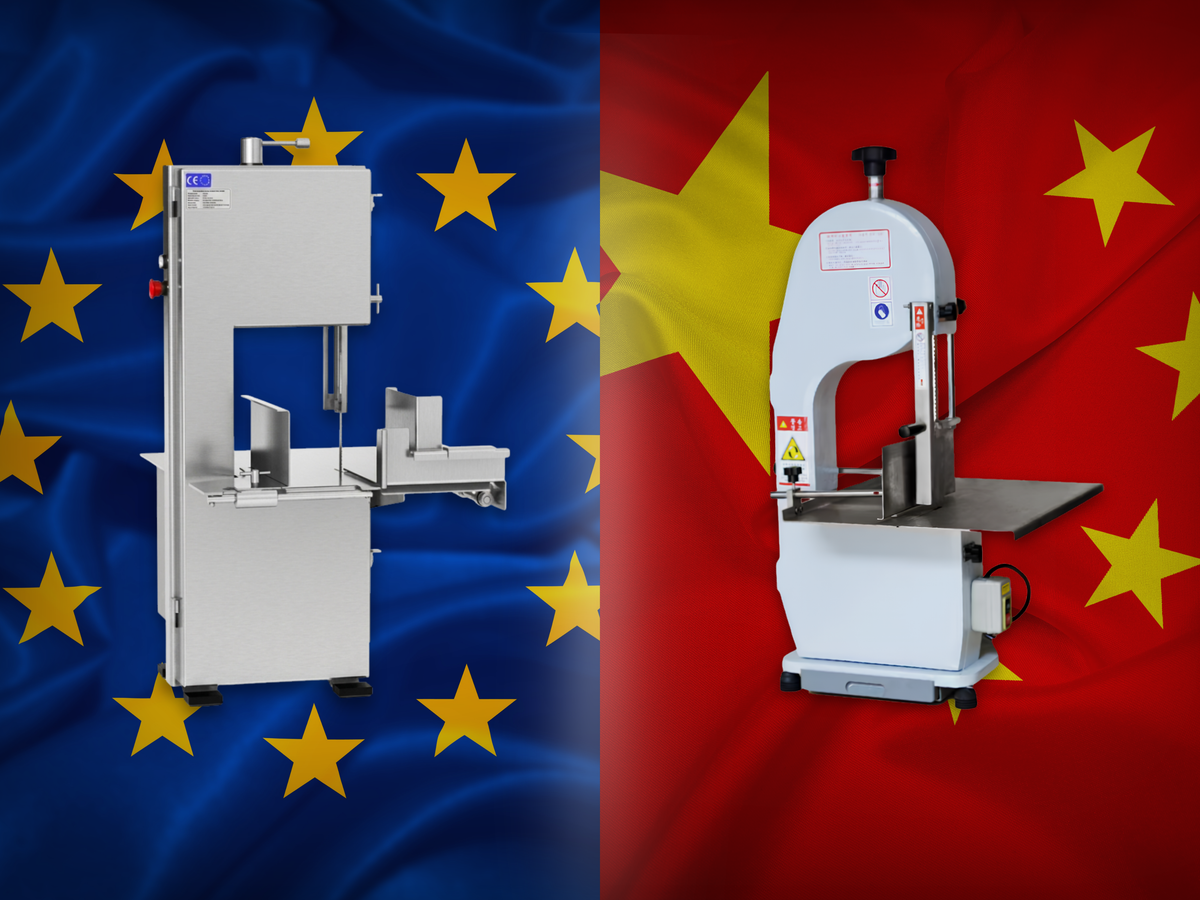
Two mincers can sit side by side, look almost identical, and be built on completely different engineering philosophies — one for a lifetime of daily commercial use, one to hit a price point.
Most professional butchery machinery sold in the UK falls into one of two camps: built in Europe, mostly Italy and Germany, by manufacturers with decades of food-machinery engineering behind them — or mass-produced for the budget end of the market, most commonly out of China, designed around a price rather than a duty cycle. This piece is a teardown of what actually separates them: the steel, the motor, the safety engineering, and what all of that means for a mincer running six days a week on a butcher's counter.
What's actually different inside the cabinet
Every food-contact part of a mincer, bandsaw or mixer should be food-grade stainless steel — usually AISI 304 grade, the standard used throughout our Omega and Medoc machines. It resists corrosion, doesn't pit under constant washdown and cleaning chemicals, and won't harbour bacteria in scratches the way lower-grade steel does over time.
Budget imports frequently swap this out where it won't show up on a spec sheet — a thinner gauge of steel, a lower-grade alloy on internal components, or a cheap coating over ordinary steel instead of the real thing. It looks the same on the shop floor. It doesn't behave the same after eighteen months of daily washdowns.
The motor and drivetrain: one shift, or every shift
This is where the gap shows up fastest in daily use. Motors built for continuous commercial duty — the kind fitted in our Omega, Medoc and Kolbe machines — are sized and wound to run mince after mince, all day, without overheating. Several of our Omega models pair this with an oil-bath gear transmission, a design refined since the 1960s specifically because it runs smoother, quieter and for far longer than a dry gear set.
A motor built for occasional home use and one built for a Saturday rush can look identical on a spec sheet. Only one of them is still running in a year.
Cheaper machines are frequently built around motors intended for light, occasional use. Pair that with plastic or nylon gears instead of a proper transmission, and the failure point becomes predictable: the machine overheats, jams or strips a gear exactly when a business can least afford the downtime.
Safety: engineered in, not stuck on
Genuine European machinery is designed against the EU/UK Machinery Directive from the drawing board, not adapted afterwards. That's why you'll find a removable feed pan with its own safety cut-out switch, a mechanical hand guard, and a plunger designed so the machine simply cannot run unless it's correctly and safely assembled — standard across the mincers we sell.
It's also worth knowing that not every safety mark on an imported machine means what it appears to. Genuine CE marking is backed by real technical testing files. There is a near-identical mark, mimicking CE's letter spacing, that some manufacturers use to imply the same compliance without the testing behind it. For a machine with an exposed blade and a powerful motor, that's not a small detail.
Our European-engineered range
This isn't an abstract argument for us — it's the reason our entire machinery range is sourced from established European manufacturers, never the cheapest thing that fits the description. Three from the shop floor:

Omega TA 32 Meat Mincer
Aluminium and AISI 304 stainless body, oil-bath gear transmission and mechanical safety protections, built by the Minerva Omega Group.

Medoc TM32/S Meat Mincer
Stainless steel throughout, Start/Stop/Reverse controls and a removable feed pan safety switch — dismantles tool-free for HACCP-compliant cleaning.

Omega C/E 165 Bandsaw
A medium-duty bone saw built for precision, power and safety — the same engineering standard as the rest of the Minerva Omega range.
Alongside Omega and Medoc, our range includes Kolbe (Germany), Sirman and CAS — all sourced from established European manufacturers. We also hold genuine replacement plates and blades for the machines we sell, so keeping one running is never a guessing game.
Two spec plates, side by side
Strip away the marketing and this is what's actually bolted to the two machines:
MOTOR CONTINUOUS DUTY
GEARBOX OIL-BATH TRANSMISSION
SAFETY CUT-OUT + GUARD, CE TESTED
DESIGN DECADES-PROVEN
PARTS UK SPARES NETWORK
MOTOR LIGHT / INTERMITTENT
GEARBOX NYLON / PLASTIC
SAFETY VARIABLE, MARK UNVERIFIED
DESIGN REVISED EVERY SEASON
PARTS OFTEN UNAVAILABLE
A machine that runs reliably for fifteen years and can be repaired the whole way through is cheaper over its lifetime than one that needs replacing every eighteen months — even if the sticker price says otherwise on day one.
The UK's home of European butchery machinery
Mincers, bandsaws and mixers from Omega, Medoc, Kolbe, Sirman and CAS, backed by genuine spares and our team's advice on the right machine for your volume.
Shop all machinery →Frequently asked questions
Why is European machinery so much more expensive than imported machines?
You're paying for food-grade stainless steel, a motor and gearbox built for continuous commercial use, genuine safety testing to EU/UK machinery standards, and a design that's often been refined over decades rather than built down to a price. Over the machine's working life, that usually costs less than replacing a cheaper machine every year or two.
Is every machine with a CE mark genuinely certified?
Not necessarily. Genuine CE marking is backed by real technical testing files. A near-identical mark exists that mimics CE's spacing without the testing behind it — easy to miss at a glance.
Do you sell any budget or non-European machinery?
No — every mincer, bandsaw and mixer we stock comes from established European manufacturers such as Omega, Medoc, Kolbe, Sirman and CAS. We'd rather stock fewer machines and know every one of them holds up in a working butcher's shop.
How do I know which size mincer or bandsaw I need?
It depends on your daily throughput and available power supply (single or three-phase). Our team can talk you through the right machine for your volume — get in touch before you buy rather than after.
What happens if a machine develops a fault?
Because our range comes from established manufacturers with a real UK spares network, we can usually source the part rather than tell you to replace the whole machine — one of the practical advantages of buying European over an obscure budget import.
Prices correct at the time of writing and may change. Always check current product pages for the latest pricing and availability.


